Monday, April 18, 2016

Local Tourist -- Belle Isle, Detroit

This past Saturday, the Local Tourist and family (at least, whoever was available, which was only Laura and Peter), wanted to do something to see different scenery.  We decided to go to Historic Fort Wayne on the south side of Detroit and along the banks of the Detroit River.  It is only $5 per car load, and there are lots of buildings to walk through.  It is only open on weekends.  Sadly, it does not open for guests until May.  So, plan B.

We headed north of the downtown and drove to Belle Isle and had a picnic along the bank of the Detroit River.  We walked through the aquarium, the conservatory, played around the fountain, stopped in briefly at the Dossin Great Lakes Museum, and walked to the Livingstone Lighthouse on the north-eastern tip of Belle Isle.

Because we have the state park passport already, the entire day was free (donations accepted at most places).  Because the day was so nice, Belle Isle was really hopping.  There were lots of bikers, joggers, picnic-ers, photographers, fishers, boaters, and people just enjoying the sun.  Workers were also in the process of getting the roads on Belle Isle prepared for the Detroit Gran Prix later this spring.  The trees were still pretty barren, only buds; but the fields of daffodils--large swaths of yellow--were scattered around the island and were in full bloom.  They were pretty.

Some photos.
Canada on port side; Detroit on starboard (assuming we are headed downriver. 

Inside the Belle Isle Aquarium.


Even though it was gorgeous outside, it is always soothing to look at palm trees.

Peter enjoys the James Scott Fountain.  It will be functioning Memorial Day weekend through Labor Day weekend.

The anchor from the Edmund Fitzgerald.  It was dropped in the Detroit River in 1974 (chain link broke) and retrieved in 1992.

Livingstone Lighthouse.


Sunday, April 17, 2016

Sermon -- 4th Sunday of Easter (April 17, 2016)

PSALM 23

I WILL FEAR NO EVIL, 
FOR YOU ARE WITH ME.

M:     Alleluia!  Christ is risen!
Cong:  He is risen indeed!  Alleluia!

In the name + of Jesus.

     Hebrew poetry is not concerned with rhyming.  The word play in Hebrew poetry is often in parallels.  For example, “Your word is a lamp to my feet and a light for my path.” (Psalm 119:105)  Lamp is parallel to light, and “my feet” is parallel to “my path.”  Sometimes the parallel is a contrast.  For example, “Righteousness guards him whose way is blameless, but sin overthrows the wicked.” (Proverbs 13:6)  The contrast there is obviously between sin and righteousness, the blameless and the wicked.  The word play in Psalm 23 is not in parallels, but in its design.  In English, when we want to emphasize something, we usually make it the first word or the punch line.  In Hebrew, the main point is put in the middle.  The words which come before and after that phrase either prove support it or are the consequences of it.  The very middle of Psalm 23 are the words: “For you are with me.” (Psalm 23:4)  
     The LORD is my shepherd.  I will fear no evil, for you are with me. (Psalm 23:1,4)  The Psalm does not say that there is no evil.  You would have to be willfully naive to think that there are no evils around us.  We see them, hear about them, and experience them all the time.  In particular, we think of the evils which can destroy us and condemn us.  For as bad as some evils are, such as a car accident, car accidents do not damn.  Sin does, and sin is always there.  We are seduced by the sinful attitudes and actions which are common around us.  And we are enticed by the sinful desires that spring up from our own hearts.  If our way is not blameless, our sins will overthrow us.  Death, of course, is always out there.  We know that the grave will one day claim us.  And the devil does all he can to pull us away from our Lord.  He tempts us, convincing us that we deserve the very things God forbids.  And then, when we have sinned, the devil taunts us so that we feel miserable in our guilt and shame.  There is plenty of evil out in the world and down in our hearts.  Therefore, let us keep watch, stand firm, and pray.
     We cannot escape the evil around us, but we need not fear it.  The LORD is my shepherd.  I will fear no evil, for you are with me. (Psalm 23:1,4)  The Lord Jesus does not abandon us or forget about us amidst the evils that we know and feel—whether they are pesky and inconvenient, or wicked and damnable.  The Lord Jesus is and remains our Immanuel.  That is the central point of Psalm 23: “For you are with me.”
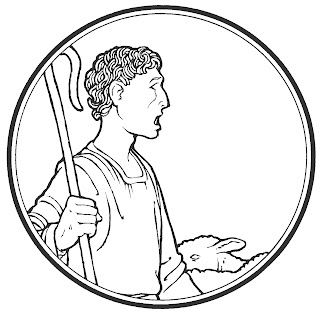
     A good shepherd always is with the sheep.  In the Judean community, every family would have had a few sheep.  A youth from the community would be hired to shepherd the flock for everyone.  He would know where to lead the sheep to make sure they got fed.  They did not go into fields protected by barbed wire fences.  They went out into open wilderness.  Predators would have pretty easy access to the sheep—unless they had a good shepherd to defend and protect them.
     Sheep are also prone to stray.  They pay attention to the little tuft of grass in front of their snouts.  Soon, they drift away, caring only about the next tuft of grass.  They are not even aware that they head right into potential death.  Therefore the shepherd calls to them so that they hear his voice and stay close where it is safe.  Likewise, we are prone to stray.  We devote ourselves to what is next on our schedules.  We fail to give head to our Shepherd's voice and end up wandering away from him, unaware of the danger we are in.  The problem is not our schedules anymore than the sheep's problem is the tuft of grass.  The problem comes when the sheep neglect the shepherd's voice.  With the shepherd, there is no danger.  Apart from the shepherd comes certain death.
      The LORD is my shepherd.  I will fear no evil, for you are with me. (Psalm 23:1,4)  This Psalm was well known to the people in Jesus' day.  So, when Jesus declared, “I am the Good Shepherd.” (John 10:11), they knew that Jesus was proclaiming that he is the Lord who shepherds his sheep.  And then Jesus went on to say what makes him the good shepherd.  “The good shepherd lays down his life for the sheep.” (John 10:11)  As a good and faithful shepherd, Jesus takes his stand between us and between all the evil that would threaten or destroy us.  With the shepherd, there is no danger.
     I will fear no evil, for you are with me. (Psalm 23:4)  Jesus Christ protects us from every evil.  You do not need to fear your sins.  Jesus Christ has taken your sins from you.  Jesus suffered the wrath of God in your place.  Your shepherd has taken the blows and let his body be rent apart so that you would not suffer.  Instead, you are forgiven.  You need not fear the devil, either.  Though he prowls around like a roaring lion, seeking to devour you, Jesus Christ has overcome him.  When the devil taunts you about your sins and tries to smear you with the shame of what you have done, Jesus speaks a more powerful and more soothing word.  To the devil, you are prey.  You are meat to be devoured.  To Jesus, you are precious.  You are the lamb he has redeemed with his life.  And he lives to claim you as his own forever.  The devil does not have you.  The devil cannot have you.  Jesus reminds you, “No one will snatch them out of my hand.” (John 10:28)  With the shepherd, there is no danger.  Therefore, “I will fear no evil, for you are with me.” (Psalm 23:4)  
     The last enemy to be destroyed is death. (1 Corinthians 15:26)  For now, it may seem that death is winning; for we are all going to die.  We have watched loved ones die.  Death overlooks no one.  But you do not need to fear even death.  The Psalmist reminds us, “Even though I walk through the valley of the shadow of death, I will fear no evil, for you are with me.” (Psalm 23:4)  Your Good Shepherd has already gone into death for you.  Death had swallowed Jesus up, but death was forced to spit him up when Jesus burst forth out of the grave.  Jesus Christ is risen, and he lives as your Immanuel.  Jesus lives to serve you as your Good Shepherd.  Even though you will walk through the valley of the shadow of death, you will walk through it.  Not even death can separate you from Jesus.  Jesus holds the keys to death and Hades, and when he comes again at the Last Day, he will deliver you from the grave to life everlasting.  Even in the face of death, I will fear no evil, for you are with me. (Psalm 23:4)  
     And it gets better.  If you are in Christ, you do not have to live your life like you are barely escaping evil all day long.  We do not cower behind walls, peak out of blankets over our heads, or tremble at the sound of everything.  I will fear no evil, for you are with me.  ...You prepare a table before me in the presence of my enemies... (Psalm 23:4,5)  We feast with our God.  Even though sin, death, and the devil are always around us, the Lord Jesus prepares a feast for us right in front of their faces.  We get to rest in God's presence and rejoice in God's care.  The table is prepared for the feast, and here Jesus Christ fills you with what you need for your salvation.  Here are the body and blood which were given for the forgiveness of your sins.  Here are the body and blood which have conquered death and the grave.  Here are the body and blood which Satan could not destroy.  Here they are—for you.  It is the feast of the Lamb given to the lambs of God.  In the face of our enemies, Jesus is with us and is given to us.  In the midst of evil, Jesus restores our souls.
     I will fear no evil, for you are with me. (Psalm 23:4)  Our Good Shepherd leads us with his words of comfort and encouragement.  And he guards us from behind with goodness and mercy following us.  Jesus knows you and loves you.  He guards you and keeps you.  He feeds you and strengthens you.  And since he shepherds you for your everlasting good, you shall not want.  You lack nothing.  For, you are his, and he is yours.  Since he is your Immanuel, you shall dwell in the house of the LORD forever. (Psalm 23:6)

In the name of the Father and of the Son + and of the Holy Spirit.  Amen. 

Friday, April 15, 2016

Chrysostom and 21st century Christians

After considering Chysostom's words again, it is apparent that context would have been helpful.  One glaring omission in the quote, as short as it is, is Jesus Christ.

Many Christians today (and even a large number of non-Christians) would agree with Chrysostom's words as they are written.  Why are we saved?  Because we are beloved by God.  In other words, just because God loves us.

Apparently, that means God either does not pay attention to our sins, or ignores them, or never was really bothered by them to begin with.  It means that there is no reason to repent, no need to turn from wickedness, and no point in pursuing godly living.  It means that the Ten Commandments are a farce, and God was kidding about his judgment and his wrath.  It means that we don't have to take God seriously at all -- except when he tells us that he loves us.  Even though we can laugh off everything else God says and does, we firmly believe that we will go to heaven because God--whom we would not take seriously in any other aspect--loves us.

This is what you are left with if Jesus Christ is removed from the picture--a god who is neither to be feared or taken seriously, and yet whom we expect will give us a place in heaven and who loves us.  Does this seem contradictory yet?

Therefore, Jesus Christ is absolutely essential to God's love for us.  Jesus is the one who reveals God's love to us.  God is serious with his Commandments, and he promises (not merely threatens -- God issues no empty threats) hellish torment to any who do not keep his Commandments.  But God also sent Jesus Christ to fulfill and obey all of the Commandments for us.  Then Jesus credits us with the work he did.  We are credited with work we did not do -- "not by laboring and sweating."

Then Jesus Christ made himself sin and a curse for us.  He bore our sin and its consequent punishment.  He endured the hellish torment at the cross.  He suffered and died the cursed death so that our death will not be cursed.  We are saved by Jesus' sufferings and death -- "not by fatigue and suffering."

This is love: not that we loved God, but that he loved us and sent his Son as an atoning sacrifice for our sins. (1 John 4:10)  This is what Chrysostom was preaching about.  But when Jesus is left out, whether in a short quotation or in an entire sermon, God's love is at best in doubt or at worst not to be taken seriously.  Only in Christ are these things sure.


Thursday, April 14, 2016

Something from Chrysostom


Image result for chrysostom

          Here is something from St. John Chrysostom ( c. 349–407), who served as bishop of Constantinople, regarding our salvation:

          "For not by laboring and sweating, not by fatigue and suffering, but merely as being beloved by God, we received what we have received." (p, 2, Homilies on the Gospel according to St. Matthew; Homily 1, part 4)

Sunday, April 10, 2016

Sermon -- 3rd Sunday of Easter (April 10, 2016)

JOHN 21:1-19

THE RISEN LORD WANTS 
HIS SHEEP FED.

M: Alleluia!  Christ is risen!
Cong:  He is risen indeed!  Alleluia!

In the name + of Jesus.

     In the upper room on the night Jesus was betrayed, the apostles got into a debate about which of them was the greatest.  Perhaps it was in conjunction with Jesus telling them that he was about to die.  If Jesus were no longer the leader, which one of the apostles was greatest and, therefore, would assume his mantle and be the next rabbi for their group?   Obviously, none of them was the greatest.  None of them was even good.  They all abandoned Jesus.  Peter made a strong case for being the worst of the Twelve, denying Jesus three times and renouncing him.
     Jesus had appeared to these faulty men twice already.  Jesus' appearances proved that their flesh-and-blood Savior who died was still their flesh-and-blood Jesus.  Only now, the body which had been crucified and buried was alive.  Jesus Christ is risen!  And Jesus was not angry with them because of their sins.  He declared peace to them so that they would not be afraid.  He absolved them so that they would not be plagued with guilt or sorrow.  The apostles rejoiced at the sight of Jesus.  Jesus lives, and sins are forgiven.
     After those two appearances by Jesus, they went back up north to Galilee, to their homeland.  Jesus had told them to go there.  But the apostles seemed to be at somewhat of a loss of what to do next.  So, they went back to what they knew.  Simon Peter said to them, “I am going fishing.” They said to him, “We will go with you.” They went out and got into the boat, but that night they caught nothing. (John 21:3)
     In the first light of the day, Jesus appeared on the shore.  He instructed the fishermen to cast their net on the right side of the boat, and he assured them they would find fish there.  The disciples pulled in an extraordinary number of fish in their net—way more than they needed for their next meal.  It would be enough to sell in the marketplace feed their families for days.
     It was all too familiar to John.  That disciple … said to Peter, “It is the Lord!” (John 21:7)  These fishermen had witnessed Jesus do this same miracle some three years prior.  Immediately after that miracle, Jesus called these men to leave their nets, to be his full-time disciples, and to train for the ministry.  Just as Jesus repeated that miracle, so Jesus repeated that call.  Jesus' resurrection did not mean that the disciples no longer had anything to do.  The risen Lord wants his sheep fed.
     After Jesus had feasted with his disciples, he spoke to Peter.  Three times, Jesus asked Peter, “Do you love me?”  It was as if Jesus were undoing Peter's three denials and reinstating Peter as a bona fide apostle.  But Jesus' first question to Peter deserves more attention.  Jesus said to Simon Peter, “Simon, son of John, do you love me more than these?” (John 21:15)  The question is “these” what?  “Do you love me more than these other apostles?”  This seems unlikely.  Jesus had rebuked the disciples for boasting about who was greater than whom.  We don't have contests in this church about who is the greatest Christian.  There are no awards ceremonies for who has the strongest faith or who has done the best works.  Such contests would not only be worthless, they would be destructive.  Even when we have such contests in our heads, we insult fellow Christians.  If anyone would dare to make such boasts, people would not be concerned if that person fell into sin.  They would cheer to see him fall from his perch and would take sinful pleasure in his humiliation.  Our place in God's kingdom has nothing to do with how great we are, how strong our faith is, or how much we do.  It has everything to do with how much Jesus loves us.  Our place God's kingdom is only ours because Jesus had done all the work to bring us into it.  Therefore, there is no room in the kingdom of God for exalting oneself—whether taking pride that I am better than you, or rejoicing that I not as bad as you.
     What seems more likely is that Jesus asked Peter, “Simon, son of John, do you love me more than these fish?”  Remember, Peter and the others had hauled in 153 large fish.  That was a lucrative day on the Sea of Galilee.  Is this what Simon would come back to when things got hard?  Is this what Simon would revert to when he struggled, when he failed, or when he felt utterly defeated?
     We all have places where we tend to flee to when life gets hard or sad or disappointing.  Some medicate themselves with alcohol.  Others bury themselves in their work.  Some just shut out everyone else.  This is how people deal with grief or guilt, heartache or hardship.  When you feel like you have been a failure as a Christian, you may be tempted to quit because you do not measure up to what you think other people think of you.  But this is precisely why the risen Lord wants his sheep fed.  Jesus Christ knows that we are weak, and he knows that we still sin against him.  While Jesus urges us to repent, to flee from sin, and to pursue what is holy, he also knows that we will fall short.  Sometimes our sins will be sorely disappointing—both to ourselves and to others.
     But the risen Lord wants his sheep fed.  That began with Peter.  Jesus did not tell Peter that he was too great a source of shame upon the Lord and, therefore, was no longer worthy of being Jesus' disciple.  We are not judged based on our merits, but on Jesus' merits.  Though we strive to be faithful, we are not graded by God on how faithful we have been.  We would never know if we have been faithful enough, and we would be back to contests about which of us is the greatest and who is more faithful than whom.  Instead, our comfort is that God is faithful to his promises, and that Jesus has been faithful for us in fulfilling all of God's promises to forgive sinners.  And so Jesus called Peter, with all his faults and weaknesses, to go and feed his sheep.  The risen Lord wants his flock to be tended with words of mercy, compassion, consolation, and encouragement.  None of us is perfect.  But we have a Savior whose love for us is perfect, whose sacrifice for us is perfect, and whose faithfulness to us is perfect.  That perfect love sustains us through all of our imperfections.
     It had not been much before this time that Peter had boasted of his greatness.  He was full of himself, thinking that he would go brilliantly to a glorious death in defending Jesus against his enemies.  Obviously, it did not work out that way.  Gethsemane was not a glorious moment for Peter.  Likewise, we may be guilty of having made great boasts about all the good we were going to do for God, only to have our boasts and our plans result in an inglorious failure.  But Jesus told Peter, “Truly, truly, I say to you, when you were young, you used to dress yourself and walk wherever you wanted, but when you are old, you will stretch out your hands, and another will dress you and carry you where you do not want to go.”  (This he said to show by what kind of death he was to glorify God.) (John 21:18-19)  In other words, Peter would get his wish after all.  He would die for Jesus.  But Peter's death would not be a mark of shame, even if it were gruesome.  God would be glorified by Peter's service in feeding his sheep and in dying for Christ's name.  In the same way, the Lord is honored by your service in his name, no matter what it is, even if it seems trivial or thankless.  You do not have die a martyr's death to honor Jesus.  All your works honor Jesus.  For, even though your works are done in weakness and remain imperfect, the blood of Jesus cleanses them and makes them good and glorious to your Father in heaven—just as the blood of Jesus makes you good and glorious to your Father in heaven.
     But no matter what you do, your greatest work is being fed by our Lord Jesus Christ.  It is he who loves us and sustains you in the Christian faith—delivering you from all your sins and consoling you with his faithful promises.  This is your glory, and this is what makes God glorious—that God loves and saves sinners.

In the name of the Father and of the Son + and of the Holy Spirit.  Amen. 

Thursday, April 7, 2016

Pastors' Conference -- Calvary in Eaton Rapids, Michigan

This past week, our Pastors' Conference was held at Calvary Evangelical Lutheran Church in Eaton Rapids, Michigan.  The altar and the communion railing are marble and rather ornate.  Pastor Mark Eckert informed me that these had come from a Roman Catholic facility and were installed by the members of Calvary some years ago.  They were concerned about if it would be centered or not, because once it was in place, they were not going to move it again.

Unfortunately, the top piece of the altar was a little too high and was replaced so that the altar could fit under the ceiling.  From what I was told, the cross they put on the top was an improvement from what had been there,  Apparently, the highlight of the altar had been the Virgin Mary and not Jesus.  The change to the top of the altar, then, was not merely practical, but theologically necessary.

Some photos.


Sunday, April 3, 2016

Sermon -- 2nd Sunday of Easter (April 3, 2016)

JOHN 20:19-31

JESUS GIVES AUTHORITY 
TO FORGIVE SINS.


M:         Alleluia!  Christ is risen!
Cong: He is risen indeed!  Alleluia!


In the name + of Jesus.

      On the evening of that day, the first day of the week, the doors being locked where the disciples were for fear of the Jews, Jesus came and stood among them... (John 20:19)  I suspect that the disciples were even more fearful of Jesus than they were of the Jews who were locked outside of their room.  They all had good reason to be afraid of him.  The last time most of them had seen Jesus, they were running for their lives out of the Garden of Gethsemane and into the dark of night.  Those who had boasted that they would never forsake him and would even die with him forsook him.  Jesus went on to die alone.  These disciples were plagued by the guilt of their faithless allegiance.  They were not good disciples.
     These guilt-ridden disciples were all gathered back in that upper room where they had feasted with Jesus.  They had heard reports of Jesus' resurrection from the women.  For the most part, they dismissed them.  But what if it were true?  What would Jesus say to them if they saw him again?  How angry would Jesus be?  Would Jesus reject them and cast them into fiery judgment?  He should, shouldn't he?  These were legitimate concerns.
     Then, Jesus appeared among them.  He was not angry.  There was no sense of regret or disappointment.  He said, “Peace be with you.” (John 20:19)  He did not breathe fire; he breathed his Holy Spirit upon them.  He did not cast them out of the kingdom of God; he gave them authority to serve in his kingdom and even to proclaim his forgiveness to others.  He came to trembling sinners and declared, “Peace be with you.” (John 20:19)
     When he had said this, he showed them his hands and his side.  Then the disciples were glad when they saw the Lord. (John 20:20)  Jesus demonstrated that it was really him—their flesh and blood Savior.  We should take to heart the fact that Jesus appeared in the flesh to declare his peace.  Although the word of God is clear in many places about God's mercy and forgiveness, Jesus did not leave these disciples to figure out for themselves that God loves and forgives the guilty.  The guilty are too frightened and confused to know or believe that God loves them.  They might hope so.  They might even insist that it has to be true.  But a guilty conscience will not let your heart have rest.
     Judas was just as guilty as the eleven with his sins.  In fact, Judas was the only one of the Twelve who actually tried to amend his sins.  Judas tried to return the money he had received to betray Jesus.  But Judas' attempt to undo his betrayal and its consequences did not take his sins away.  Wanting to be freed from his guilt did not make Judas free from his guilt.  Judas Iscariot was so overcome by his guilt and grief that he sought relief in suicide.  Sadly, that faithless death only resulted in endless grief and eternal sufferings.  The remaining disciples huddled together in the upper room.  They, too, wanted to be freed from their guilt and shame.  But banding together for mutual consolation could not take away their sins or relieve their guilt.
     Therefore, Jesus himself appeared to these disciples.  The very one who had taken their sins to the cross delivered the message of forgiveness to them.  Jesus did not speak about some nebulous forgiveness.  Jesus personally declared that their sins were forgiven.  Jesus knew they had failed.  He knew all their faults.  And he still loved them.  He declared, “Peace be with you.” (John 20:19)  Jesus had authority to forgive their sins, and so he did.  As he declared it, so it was done.
     Now, our sins are just as real as those of the disciples.  Every day we strive to be faithful to our Lord and obedient to his word.  But we forsake God's truth when holding firm to it costs too much.  Our society desires to be free from God and his word, and our nation fulfills the warning from St. Peter, “With respect to (sinful attitudes and immoral behavior) they are surprised when you do not join in with them in the same flood of debauchery, and they malign you.” (1 Peter 4:4)  We do not like to have abuse heaped upon us.  And so even Christians adopt worldly attitudes, get drunk, sleep around, turn to obscenities, and back away from God's word when people sneer at us for believing it and living like we do.  We like being popular with the world more than being faithful to God because we favor immediate pleasure over future glory.  So, how should the Lord treat us when we abandon him because it was hard or inconvenient to be faithful Christian?  Repent.
     If you feel guilty over your sins, if you feel ashamed of your cowardice, if you are burdened by your lack of faith and obedience, you are where the disciples were in the upper room.  At those difficult times, you may think of reasons why your sins should not trouble you any longer.  But how can you trust your thoughts?  Depending upon your mood, you can convince yourself how awful you are or how wonderful you are.  If you believe you are so awful, despair may lead you where Judas went.  If you believe you are so wonderful, is that God's word or are you just telling yourself how wonderful you are?  No matter how convinced you are of your own opinion—whether you are awful or wonderful—God's judgment is the only one that matters.  Therefore, if you want to have peace, you need God's word to deliver it.
     The Lord Jesus appeared to his troubled disciples in the upper room on Easter evening to absolve them of their sins.  He does not appear in person any longer.  But this is what he does instead.  Jesus said to them again, “Peace be with you.  As the Father has sent me, even so I am sending you.”  And when he had said this, he breathed on them and said to them, “Receive the Holy Spirit.  If you forgive the sins of any, they are forgiven them; if you withhold forgiveness from any, it is withheld.” (John 20:21-23)  
     Jesus gives authority to forgive sins to his disciples.  The same authority Jesus has to forgive sins he gives to his disciples.  And the Church calls ministers to apply that forgiveness to troubled sinners.  If you are troubled by your sin and guilt, you will not find peace in some nebulous forgiveness out there.  How would you ever know that Jesus forgives you, and that he forgives that sin?  He does this by sending flesh-and-blood ministers to speak in his stead and by his command.  “As the Father has sent me, even so I am sending you,” (John 20:21)  Jesus said.  Jesus gives authority to forgive sins.  Through his ministers, Jesus applies to you personally the forgiveness of your sins.  Yes, Jesus knows that you have failed.  He is aware of all of your faults.  And he still loves you.  He does not look upon you with disgust or disappointment.  Rather, he looks upon you with mercy and desires you to live without guilt or shame or fear.  So Jesus gives you a personal word of forgiveness, and you hear it when his minster declares, “I forgive you.”  It is Jesus' “I” that you hear.  It is Jesus' forgiveness that is applied to you.  It is declared with Jesus' authority and backed by Jesus' own promise: “If you forgive the sins of any, they are forgiven them.” (John 20:23)
     Jesus gives authority to forgive sins.  And he is not chintzy with his forgiveness.  You are all disciples of Christ.  You are all priests of God and servants of the Lord.  And you all have friends who carry upon them the burden of guilt and shame.  Many of them live in terror at the idea of seeing Jesus.  They expect him to be angry, and for good reason.  They need the very forgiveness that you have.  And you get to be the voice that Christ uses to bring relief to guilty hearts and comfort to troubled souls.  Jesus gives authority to forgive sins to you, too.  It is his word.  It is his good news.  And it is meant for everyone Jesus died for – that is, everyone.
     Jesus gives authority to forgive sins.  He does this for your benefit so that you can know, without a doubt, that your sins are forgiven.  He grants peace to troubled sinners, and he brings joy to grateful saints.

In the name of the Father and of the Son + and of the Holy Spirit.  Amen.