Here is the Divine Service from Sunday, October 18, 2026. My apologies for the feedback on the mic at the beginning of the service.
Showing posts with label history. Show all posts
Showing posts with label history. Show all posts
Monday, October 19, 2026

Sunday, October 18, 2026
Sermon -- Festival of St. Luke, Evangelist (October 18, 2026)

ST. LUKE WROTE THE HISTORY SO
YOU CAN HAVE CERTAINTY.
LUKE 1:1-4
In the name + of Jesus.
More and more these days, I am becoming a
skeptic. I wish I did not have to be,
but I know that people often tell their stories with an agenda. Different news outlets can report on the same
story, but you would never guess they are covering the same thing. They report the version of the story that
favors their audience. That is on
purpose. CNN and FOX both know what
their audiences are looking for. To keep
their audience, they cater to their political leanings. Sadly, it is to the point where I will listen
to a report and say, “Well, that’s good (or bad)—if it’s true.”
If you have become more skeptical over
time, that is no surprise. No one wants
to be played for a fool. No one likes
being lied to. So, every story is
treated with suspicion. We learn to be
careful. News is reported, and then we investigate
to see if it is accurate or if it is biased.
Sometimes, we have no way of knowing, and that is frustrating. It is also a terrible way to live, never
really trusting anyone.
When St. Luke wrote his Gospel, it was
written to someone named “Theophilus.”
Theophilus means “Friend of God.”
His Gospel may have been written to Christians in general; for each of
us is a “Friend of God.” But even if St.
Luke wrote to a specific individual named Theophilus, his Gospel was intended
for Christians everywhere. I don’t know
if Theophilus was a skeptic or not, but St. Luke wrote to remove any doubts
about Jesus Christ. He wrote, “It
seemed good to me … to write an orderly account to you, most excellent
Theophilus, so that you may know the certainty of the things you were taught”
(Luke 1:3-4). St. Luke wrote the
history so that you can have certainty.
The Bible calls Luke a doctor, which he
was. But he was also an incredible
historian. Luke places Jesus firmly in a
historical time and place. This is no
“Once upon a time in a land far, far away.”
This is “while Quirinius was governing Syria” (Luke 2:2). This is “in the fifteenth year of the
reign of Tiberius Caesar—while Pontius Pilate was governor of Judea, Herod was
tetrarch of Galilee, his brother Philip was tetrarch of the region of Ituraea
and Trachonitis, and Lysanias was tetrarch of Abilene—during the high
priesthood of Annas and Caiaphas” (Luke 3:1-2). This is in places like Nazareth, Bethlehem,
Capernaum, and Jerusalem. If this were a
mythical tale, Luke would not have named people and places that could be
verified. But Luke presented details. He logged specific dates. He labeled specific places. He named specific people. St. Luke wrote the history so that you can
have certainty.
Many writers have attempted to teach
virtues, morals, and even spiritual insights.
Aesop wrote fables, almost all of which include talking animals. Aesop’s Fables may help teach morals, but they
are fictional. Mohammed’s writings have
no historical placement at all. They are
statements which cannot be verified by any historian. Joseph Smith, the founder of the Mormons,
claimed to receive his revelation from golden tablets that no one has seen,
written in a language that no one had ever heard of. By contrast, the writers of the Bible
included historical and geographical information. They practically beg you to verify what they
are writing. Historians and
archaeologists have vindicated the Biblical record over and over again. There is no need for skepticism. The Bible records the history so that you can
have certainty.
Even if people do not believe it, the
Bible records some certainties that all people acknowledge. For example: No one is perfect. That’s why we have erasures on pencils and
delete buttons on our computers. These
can correct our mistakes. Of course, no
one goes to hell for mispronouncing a word or being bad at algebra. But our imperfections go far beyond grammar, spelling,
or math. The Bible asks, “Who can
say, ‘I have made my heart pure; I am clean from my sin’” (Proverbs 20:9)? In case you get stuck on that question, the
Bible gives you the answer: “There is surely not a righteous man on earth
who does good and does not sin” (Ecclesiastes 20:7). With every spiteful, petty act, with every obscene
word, with every unkind or envious thought we sin against our fellow man and
against our God. No one is perfect. No heart is clean. No mouth is pure.
Our sinfulness leads to another certainty:
All people die. The Bible states why: “The
wages of sin is death” (Romans 6:23).
Death is the curse we must suffer because we are sinners. But there is a greater reason that death
fills us with dread. The Bible reminds
us, “It is appointed for people to die only once and after this comes the
judgment” (Hebrews 9:27). God gave
our lives to us, and he holds us accountable for what we think, say, and
do. Since the world he created and the
people he put in it were perfect, that is what he still demands of us. And that is why people are terrified of
death. For, no one is perfect. No heart is clean. No mouth is pure. Death is certain. Judgment is certain. And we certainly have earned a sentence of
condemnation.
St. Luke recorded the history of Jesus so
that you can be certain of a better future.
St. Luke began his gospel describing how our Lord entered history for the
benefit of mankind. Luke was not merely
telling his version of how it may have happened. Luke testified, “I followed everything
closely from the beginning” (Luke 1:3). The
verb suggests that Luke investigated everything. It seems likely that he interviewed those who
were eyewitnesses. Twice Luke commented
that Mary pondered all these things in her heart (Luke 2:19,51). That suggests that Luke interviewed Mary
about all she had seen and heard. Luke
recorded the history so that you can have certainty.
In fact, Luke had to record these things
because the way our Lord entered the world was miraculous. Mary did not understand it either. Having heard that she would conceive and give
birth to a son, Mary replied, “‘How will this be, since I am a virgin?’ The angel answered her, ‘The Holy Spirit will
come upon you, and the power of the Most High will overshadow you. So the holy one to be born will be called the
Son of God’” (Luke 1:34-35). The
Lord revealed the mystery to Mary so that she could be certain about her
inexplicable pregnancy. St. Luke recorded
this so that you can be certain too. He
recorded the mystery not so that you could understand it, but so that you would
know it. Luke recorded the history so
that you can have certainty.
For many, the incarnation of our Lord is
offensive and worthy of mockery. Many
also dismiss the accounts of Jesus’ miracles and his teachings. Unbelief despises everything about Jesus,
even things that can be verified. Some
deny that Jesus ever existed. But
ancient historians who have no allegiance to Jesus of Nazareth, such as
Josephus and Tacitus, acknowledge that he was a real man and that he was
crucified. St. Luke and all the apostles
testify that Jesus’ crucifixion pays for the sins of all, but all who reject
Jesus also reject the benefit of Jesus’ saving work and his deliverance from
damnation.
The skeptic may have questions about
Jesus, his teachings, and the entire Bible.
Such questions are not inherently evil; and chances are, you have some
of those questions yourself. Some of
Jesus’ teachings are hard. They may be hard
to understand, or they may be hard to put into practice. If you have questions about such things, you
are not alone. Anyone who is a skeptic
craves certainty. And even the faithful
long for greater certainty.
Beware.
The devil uses that skepticism to seduce you into unbelief. He speaks through people who challenge you: “You
know, if you can’t find a reasonable solution to the mysteries of God, they are
not worth your time. You are too smart
to believe such nonsense.” “You know, the
people who challenge God’s word are asking really good questions. The fact that you do not know how to answer
those questions proves that there are no good answers to those questions. You are a fool to keep on believing the
Bible.” Some of these challenges
sound very compelling. We expect that
God’s will and God’s ways should match our own.
We think that everything about God should make sense to us. We think that God should be like we are.
Repent.
It is a lie. The Bible proves
that God is not like us. And God be
praised for that! We are not as
powerful, wise, or merciful as our Lord us.
If we were, we would use our power and wisdom to exalt ourselves. The Lord uses his power and wisdom for the
benefit of sinners. St. Luke records how
God’s mercy is not merely a theory.
God’s mercy is real—displayed in a historical time in a historical place
by a historical man, Jesus Christ. Luke
recorded the history so that you can have certainty.
Before Jesus ascended into heaven, he told
his apostles, “Everything must be fulfilled that is written about me in the
Law of Moses, the Prophets, and the Psalms. … This is what is written and so it
must be: The Christ will suffer and rise from the dead on the third day, and
repentance and forgiveness of sins will be preached in his name to all nations”
(Luke 24:44,46-47). St. Luke
recorded how Jesus fulfilled the promises of old. He recorded how Jesus suffered and died to be
the atoning sacrifice for sinners—for the penitent, the skeptic, and even the atheist. Jesus has paid the price for all sinners and
has taken away all sins. He rose from
the dead and “presented himself alive to the apostles with many convincing
proofs” (Acts 1:3). Those who were witnesses
of all these things suffered torture, persecution, and death rather than deny
it. Jesus sent them into the world to preach
about the death that pays for sins and the resurrection that opens heaven to
all who believe. And so that you would
have this testimony made known to you, it was written down for your benefit.
St. Luke recorded the history so that you can have certainty. He testified about a real Jesus who suffered real torment and died a real cursed death for sinners. He overcame a real death with a real body to bestow real mercy and give real hope to sinners. This is good. For our Lord does not come to save theoretical sinners. He comes for real sinners. He grants a full pardon for all your sin. He speaks tenderly to you when your heart is full of doubts. He reveals his wisdom in the Scriptures to answer your questions about life and death, good and evil, wisdom and foolishness. Not being able to trust anyone is a terrible way to live. God be praised! You don’t have to, not with God and his word. St. Luke recorded the history so that you can have certainty of the facts, comfort for your spirit, and confidence on the Last Day.
In the name of the Father and of the Son + and of the Holy Spirit. Amen.
Saturday, October 9, 2021
City of Novi: The Watertower
Below is s video about the City of Novi's watertower. If you've been here, you've almost certainly seen it. Nice job, City of Novi!
Friday, April 2, 2021
Something from ... Cranach, the Blog of Veith

Veith also provides some links for further reading and contemplation (full disclosure: I have not checked those out yet). But the article linked is worth a look.
God bless your Good Friday meditation and worship.
Roman Drawings of Crucifixions (and What They Tell Us) | Gene Veith (patheos.com)
Wednesday, July 1, 2020
Schroeder Vacation, Part 1 -- Western Michigan: Muskegon
The end of June took some of the Schroeder family to western Michigan for a week of vacation. We had hoped for a longer trek, but COVID-19 restrictions and concerns kept us close to home. And while we did not get to travel far, we did get to explore parts of the state that we had not really visited before. Having lived in Michigan now for only 24 years, we finally got to visit something new in such places as Muskegon, Holland, and South Haven.


Our trip could be summed up in one blog post, but photographs demand that I break this up into 3 or 4 entries. The first entry will focus on Muskegon and, in particular, the USS Silversides Museum. Besides touring the submarine USS Silversides, there is a WWII museum. If you go, plan on taking a few hours to read through all the history of WWII documented there. It focuses mainly on action in the Pacific Theater, but there is a timeline that covers everything leading up to WWII and in more detail from events from 1941-1945.
In addition to touring the USS Silversides submarine, they also had a Coast Guard vessel to walk through.
Muskegon has more to offer, but we limited ourselves to the museum for one day. While it was worth the visit, we found it pretty hard to find. The signs directing us were somewhat sparse, and we often wondered if we were on the right track. Once we failed to decipher a particular direction and took a wrong turn (we blamed an arrow which pointed neither straight nor to the left, but in between those directions, and we guessed wrong).
For the particularly adventurous, you are able to sleep overnight on the USS Silversides. We were not that adventurous, opting for a much more comfortable night's sleep at Hoffmaster State Park. Here are some photos.


Friday, November 8, 2019
The history of Novi -- How Novi became a city
Novi celebrates its 50th anniversary this year. Below is a video about how Novi Township became the city of Novi in 1969.
Friday, October 11, 2019
City of Novi -- 50th Anniversary: Police and Fire Departments
Here is another video from Novi's 50th Anniversary. This one features the history of the Novi Police Department and Fire Department. Novi's first responders are such a blessing to the city. We often see the Novi Police parking in our parking lot, either logging official business or taking a break. (I have never bothered them to learn what they are actually doing.)
Enjoy the history lesson.
Friday, October 4, 2019
Things that make me go, HMMMMMMM... and the city of Novi
Novi is celebrating its 50th anniversary, and the city has been putting out YouTube videos about the history of the city. This month's installment has to do with the Novi Expo Center (now a vacant lot, but being developed for something new) and the Suburban Collection Showplace.
If you are driving into Novi from the west on I-96, you will notice a large water town with the word "Adell" on it. It always made me go HMMMMM, wondering who or what Adell was. The video below references (not much, but it does) Frank Adell, who was involved with the Novi Expo Center. Mystery solved.
It also shows how Novi has grown. Back when the Novi Expo Center had only one entry off of Novi Road, the traffic on weekends was horrendous. It was best to avoid Novi Road and Grand River at all costs. Traffic on Novi Road is a lot happier on weekends now that they have two different directions of entry into the Suburban Collection Showplace.
You can watch the video about the Novi Expo Center and the Suburban Collection Showplace here.
Tuesday, August 6, 2019
History of Novi -- Parks & Recreation

For the 50th anniversary of the city of Novi, a number of videos have been put together.
Here is a neat one on the Novi Parks & Recreation history.
Enjoy!
Sunday, August 4, 2019
Traveling with the Schroeders -- Summer 2019
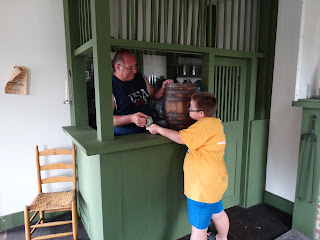
We have tried to make the most of the summer with varying degrees of success. I don't know if the rest of the family feels this way, but I am always more eager to do more than is probably realistic. Nevertheless, we have managed to enjoy some camping, beach time, and other touristy activities. Here are a few photos from our summer activities.




 |
| Greenfield Village, always a summer favorite |


 |
Peter at Mission Point Lighthouse with his cousins, Abby & AJ.
They are exactly half way between the North Pole and the Equator.
|

 |
| Laura enjoys some wine tasting with her brother, David. |

 |
| Traverse City State Park |


 |
| Swimming at Island Lake Recreational Area |


Subscribe to:
Posts (Atom)